
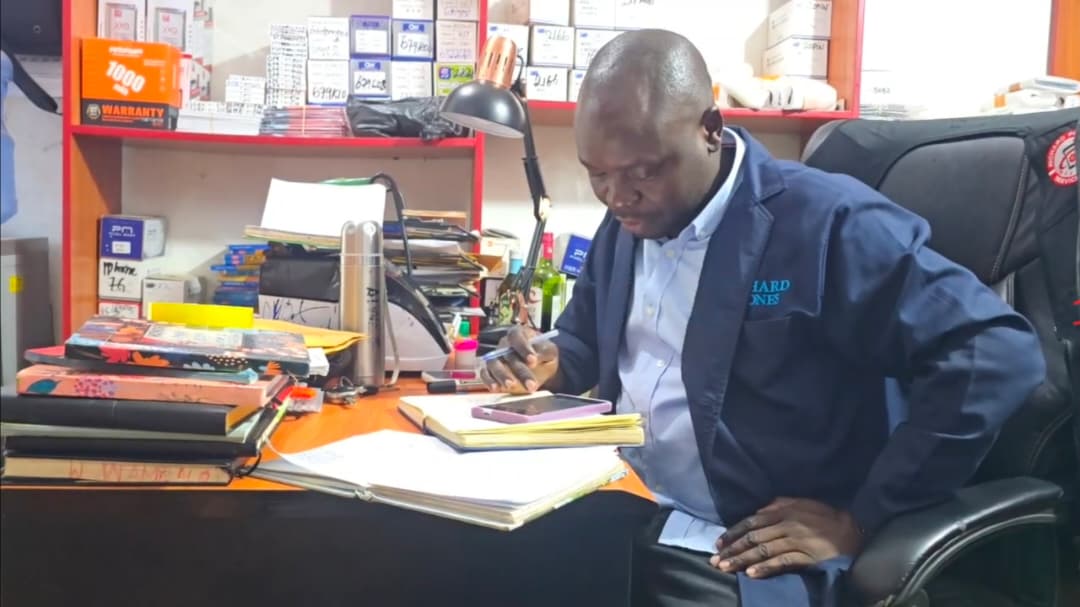
MBALE — As authorities across Uganda intensify enforcement of trade order regulations to clear vendors from streets and pavements, many informal traders fear losing their livelihoods. For Richard Wambalo, however, a crackdown that once threatened his survival became the catalyst for a remarkable business success story.
Today, Wambalo owns Richard Phones, a growing enterprise specialising in mobile phone repairs, accessories and spare parts. The business operates three outlets in Mbale City, imports products directly from China and Dubai, and employs approximately 18 young people.
His journey began in Bududa District, where financial hardship cut short his education following the death of his father.
"I was always being sent home because of school fees. My mother was under immense pressure until I finally gave up," Wambalo recalls.
He dropped out of school in Senior Three while studying at Bulucheke Secondary School and moved to Mbale to live with his elder sister, Grace Nabutsale Masai.
"We lived in a tiny room where Richard even shared a bed with my son," Masai says. "I gave him some money to start selling maize flour, but he soon lost interest. Later, I discovered he had made friends in town who introduced him to phone repair."
After struggling to find work, Wambalo secured an opportunity at a phone repair shop along Naboa Road, where a technician identified as Denis hired him at a daily wage of Shs1,500.
"My first job was reviving completely drained phone batteries by fastening exposed charger wires directly onto the battery terminals. That was before smartphones became common," he says.
Although he had never received formal training, Wambalo developed a keen interest in phone repair. He closely observed technicians at work, listened carefully to customers' descriptions of faults and studied every repair process.
His dedication caught the attention of his employer, who gradually began teaching him the trade.

After mastering the skills, Wambalo struck out on his own, renting space for a small repair desk along Republic Street at Shs50,000 per month.
"Those days we repaired button phones such as the Nokia 3310 and Siemens. Nokia dominated the market long before brands like Tecno and itel arrived," he says.
His breakthrough came when he solved a common technical problem affecting many Nokia phones.
"Many mechanics struggled with Nokia phones showing SIM card errors. I studied the problem until I understood it. Soon other technicians were referring customers to me, and that's how my name spread."
The defining moment in his entrepreneurial journey came in 2016 when Mbale Municipal Council intensified enforcement against street trading.
Like hundreds of other traders, Wambalo was forced to vacate his roadside workspace.
Rather than abandon the business, he negotiated for a three-foot operating space inside an electronics spare-parts shop owned by veteran trader Muzee Joseph.
What initially seemed like a setback soon became a turning point.
Operating from inside a shop increased customer confidence and shielded him from the constant disruptions caused by enforcement operations. His daily repair earnings doubled to about Shs150,000, and he later expanded into selling spare parts.
"At first, I saw moving into a shop as a setback. I thought leaving the street would reduce my visibility and cost me customers. But reality proved me wrong," Wambalo says.
"Customers trusted my work more, came more often, and were willing to pay better."
By 2021, he had accumulated enough savings to rent his own premises.
Today, Richard Phones operates three outlets across Mbale City and continues to expand.
Muzee Joseph, who offered Wambalo his first indoor workspace, says witnessing his growth has been gratifying.
"He has never forgotten where he started. He still comes back to visit us in appreciation of the role we played in his journey," Joseph says.
His success has also transformed the fortunes of his family.
"Richard has become a pillar of our family," says his sister. "He was the first among us to travel overseas. I work as an auditor in Bududa, yet I have never boarded a plane, while he now travels regularly to China and Dubai to import merchandise."
Wambalo attributes his achievements to patience, honesty, discipline and consistency.

His story comes as urban authorities across Uganda intensify efforts to enforce trade order regulations. In recent months, Kampala Capital City Authority (KCCA) and several city councils have removed vendors from streets, arguing that roadside trading contributes to congestion, generates waste, obstructs pedestrians and creates unfair competition for licensed businesses.
Mbale City Town Clerk Assey Abirebe says the objective of enforcement is not to frustrate traders but to promote orderly business operations.
He encourages small-scale traders to begin in gazetted markets such as Mbale Main Market, Kumi Road Market, Kikindu Market and Pallisa Road Market before expanding into permanent business premises.
"Markets are like business nurseries," Abirebe says. "Every entrepreneur starts somewhere. As traders accumulate capital, they can graduate from the markets and rent shops along the streets."
Wambalo shares similar advice, urging traders with limited resources to pool capital and jointly rent premises or negotiate for small spaces within existing businesses rather than operating on the streets.
Looking back, he remembers how enforcement operations repeatedly interrupted his work and affected customer confidence.
"Customers often walked away because whenever council officers arrived, I had to hide my desk. It became difficult to build a reliable customer base," he says.
While acknowledging that trade order enforcement can create short-term challenges, Wambalo believes it can also encourage entrepreneurs to formalise their businesses and achieve long-term stability.
His journey from a roadside repair desk to a growing enterprise employing 18 young people illustrates both the challenges and opportunities facing Uganda's informal business sector, while highlighting the importance of affordable workspaces, access to capital and supportive urban policies that help small enterprises grow.
